
A COMMON TERRITORY
Book presentation
December 2nd, 2025, 4:00 p.m.
LiDA (ESAD Caldas da Rainha)
Presentation by Luís Costa, with Susana Duarte and Ricardo Jacinto (organizers of the artistic residencies and editors of the book)
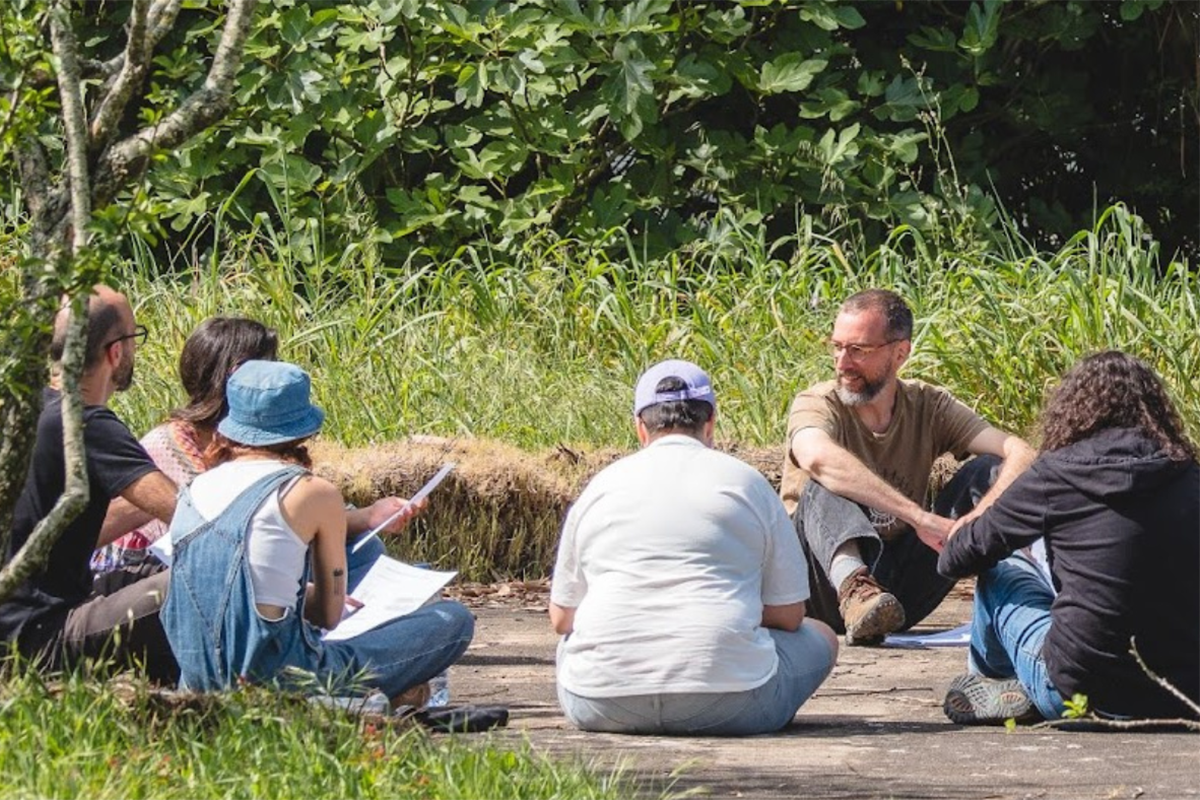
“A Common Territory” brings together projects developed within the scope of the artistic research residencies of the Master’s Degree in Sound and Image Arts at ESAD CR, carried out in collaboration with the OSSO Cultural Association, in the territory of São Gregório da Fanadia.
These residencies are intended to be a space for experimentation and collective reflection, where students are challenged to create short-term projects in a laboratory context, with the guidance of guest artists and the support of the course teachers.
The book documents this experience, giving shape to an archive in progress: not so much a compilation of results, but above all a visual and discursive reflection on emerging creative practices at the intersection between research, pedagogy, and territory.
By bringing together images, texts, and fragments of the process, this publication attempts a possible translation of the creative space opened up by the residencies—extending and reinventing it in another medium.
Luís Costa
Economist and PhD candidate in Artistic Creation at the University of Aveiro, Polytechnic Institute of Porto, and ESAD. Since 2004, he has worked as a curator and programmer of contemporary artistic practices, sound and multimedia artist, and educator and cultural animator in rural contexts.
He is president of Binaural Nodar, an association dedicated to sound and multimedia art and social research in the rural area of Viseu Dão Lafões, which has hosted more than 175 sound/multimedia artists and social and environmental researchers. He is the coordinator of the Binaural Nodar Digital Archive, a project for the research, cataloging, and sound and audiovisual mapping of the collective memory of the rural areas where the association operates, which has more than 2,000 sound and audiovisual documents and is part of the European Tramontana network of memory archives of mountainous areas, which in 2020 won the Prix Europa Nostra: European Cultural Heritage Award in the research category.
He is the author/editor of twelve books dedicated to artistic creation, especially sound and media, in rural contexts, rural ethnography, and ethnomusicology, namely the catalog “Three Years in Nodar: Artistic Practices in a Specific Context in Rural Portugal,“ which he co-edited in 2011, the book ”Tales of Sonic Displacement: SoCCoS, a sound-based artist residency network,“ which he co-edited in 2016, and the book ”Memoria Tramontana: Changes in rural Europe as seen by its inhabitants,” which he co-edited in 2019.
Ricardo Jacinto
Musician, visual artist, and architect with artistic and academic research focused on the relationship between sound and territory in transdisciplinary practices. He is a founding member and artistic director of the OSSO collective and holds a PhD from the Sonic Arts Research Center, Queens University Belfast.
Since 1998, he has presented his work in solo and group exhibitions, concerts, and performances in Portugal and Europe, and has collaborated extensively with other artists, musicians, architects, and performers. His music has been released by Clean Feed, Shhpuma Records, and Creative Sources. He is represented by Galeria Bruno Múrias and his installations are present in several national collections: Fundação de Serralves, Caixa Geral de Depósitos, Fundação Leal Rios, and Fundação António Cachola. He was co-representative of Portugal at the 10th Venice Architecture Biennale in 2006 and his work has been presented in different venues, such as Culturgest (Lisbon and Porto), Fundação Serralves, Fundação Calouste Gulbenkian, Palais de Tokyo, Mudam, Teatro Maria Matos, Museo Vostell, Casa da Música, CCB, Manifesta 08_European Biennial of Contemporary Art, Frac Loraine_Metz, and OK CENTRE_Linz, among others.
Susana Nascimento Duarte
Susana Nascimento Duarte is an associate professor of film and video at ESAD CR/IPL, where she coordinates the master’s degree in sound and image arts. She holds a PhD in “Cinema and Television” from the Faculty of Social and Human Sciences (FCSH/UNL).
She is a research member of Cinelab – Cinema Laboratory – at the Institute of Philosophy of Universidade Nova (IFILNOVA/FCSH/Universidade Nova de Lisboa). She is currently co-principal investigator of the funded exploratory research project “Mediating the real. Philosophy and documentary cinema” (IFILNOVA/FCSH/UNL).
She has been involved in the research projects “Cinema and Philosophy. Mapping an Encounter“ (IFILNOVA/FCSH/UNL, 2008-2013), ”False Movement: Studies on Writing and Cinema“ (CEC/FLUL, 2010-2015), and ”Fragmentation and Reconfiguration: Experiencing the City between Art and Philosophy” (IFILNOVA/FCSH/UNL, 2018-2022).
As part of his research and teaching activities, he has published several articles, interviews, and book chapters, presented numerous papers at colloquiums, seminars, conferences, and festivals, and organized colloquiums, seminars, round tables, open classes, masterclasses, and artistic residencies.
She has worked on the relationships between technical images and perception, figural thinking, the intersection between visual arts and cinema, archival and counter-archival practices, and is currently researching the aesthetics of documentary images and cinema as a potential archaeological tool for critiquing digital culture and the contemporary world in the context of “post-cinematic” artistic practices.
She was one of the programmers of the series of encounters “What is the Archive?”, organized by Videoteca/Arquivo Municipal de Lisboa, and of the Art-Archive (Calouste Gulbenkian Foundation, 2017), Cinema-Archive (Cinemateca Portuguesa, 2018), and City-Archive (Biblioteca de Marvila, 2019) laboratories.
She is the editor of interviews for the magazine Cinema: Journal of Philosophy and the Moving Image.
She co-edited Images of the Real. Philosophy and Documentary Film, a special issue of Cinema: Journal of Philosophy and the Moving Image 12 (2020). She has also worked as a director since 1996, having directed films such as Materiais de Construção (2001), Atelier (2011), and Jardim de Infância (2023).
Photograph by João Quirino.
Binaural Nodar is a cultural entity supported by the Portuguese Republic – Culture, Youth and Sports | Directorate-General for the Arts.