
TRANSHUMANCE IN EUROPE
Screenings of films and testimonials from field research
Presentation by Tramontana Network partners
September 26th, 2025
8:45 p.m. to 10:00 p.m.
Multipurpose Hall, Arsita (Teramo, Italy)
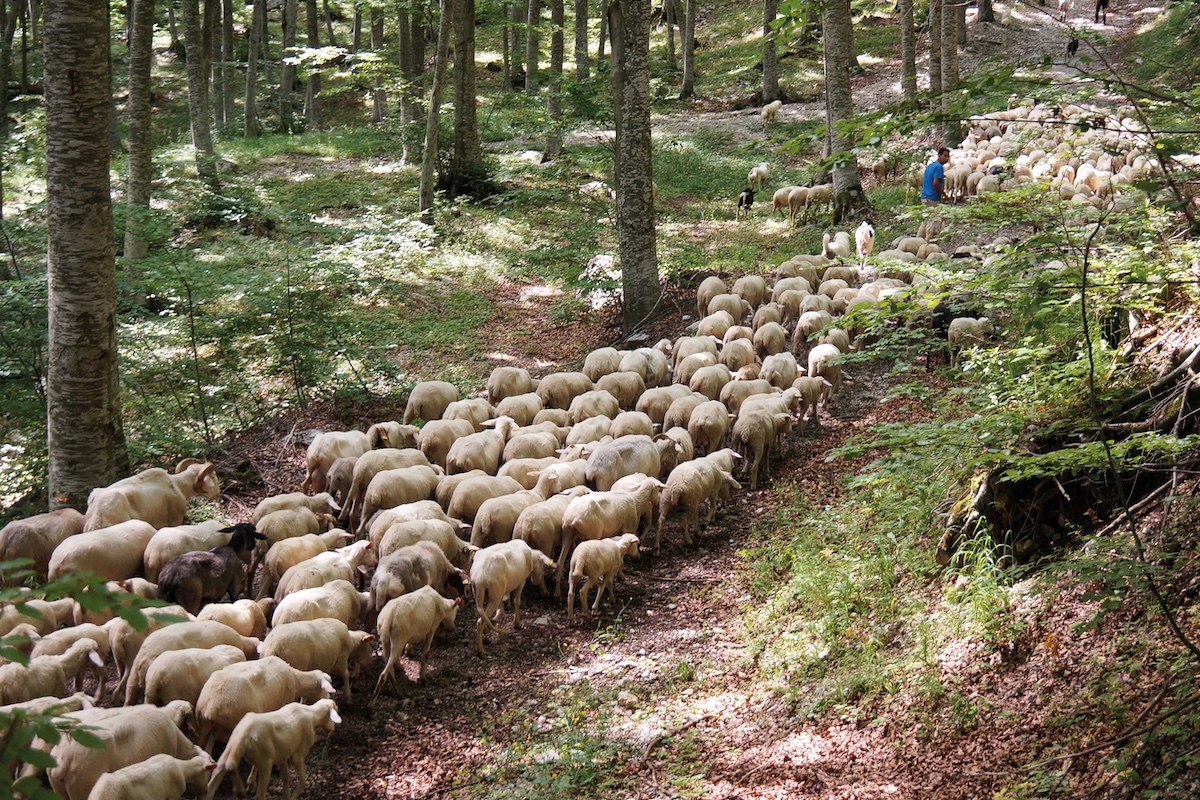
Transhumance is a particular form of guided livestock farming and pastoralism in which animals are moved seasonally, for a limited period of time, to higher pastures or back to lower ones, between the mountains and the plains. It is a system of knowledge, skills, and practices that, in its phenomenological breadth and historical depth, can be understood as a complex, integrated, and inclusive organism. A cultural manifestation of the pastoral world of great significance, transhumance has given rise to transregional and cross-border mobility networks, fostering early exchanges between European populations and cultures. Present today in many areas of the continent, it marks both a way of using the land and a way of knowing and defining spaces and landscapes, shaping the relationships between people, animals, and ecosystems.
These recordings are related to some concrete forms of mobile pastoralism on the vast European continent, shaped in different ways but united by the same structural need: to ensure the seasonal transfer of animals in search of better pastures. The journey follows the course of the continental territory from west to east, and the subtle connections that link this phenomenon in a dense web of itineraries and common elements that can be found even at great distances, from the Iberian Peninsula to southeastern Europe, crossing eight countries and the main mountain ranges involved in the research: from the Portuguese Montemuro Massif to the Spanish and French Pyrenees, from the Italian and Austrian Alps to the Italian Apennines, from the Albanian Alps in the Western Balkans to the Romanian and Polish Carpathians.
The practice of transhumance, in such a wide environmental scenario, involves rituals and social customs based on sharing, collective care and attention in raising animals, managing land and pastures, and facing natural dangers together. It is the contemporary expression of a refined capacity for cooperation between humans, animals, and plants, exercised over millennia, the result of an elaborate process of co-adaptation and virtuous sharing between species of a habitat, a landscape, and its resources, which today faces new challenges such as the problematic coexistence of the agricultural and pastoral world with large predators and wildlife.
Since 2019, transhumance has been inscribed on the Representative List of the Intangible Cultural Heritage of Humanity by virtue of a decision adopted by the UNESCO Intergovernmental Committee for the Safeguarding of the Intangible Cultural Heritage, based on a transnational nomination proposed by Italy, Austria, and Greece, which was then extended to Albania, Andorra, Croatia, France, Luxembourg, Romania, and Spain in 2023.
Binaural Nodar is a cultural organization supported by the Portuguese Republic – Culture, Youth, and Sports | Directorate-General for the Arts.