
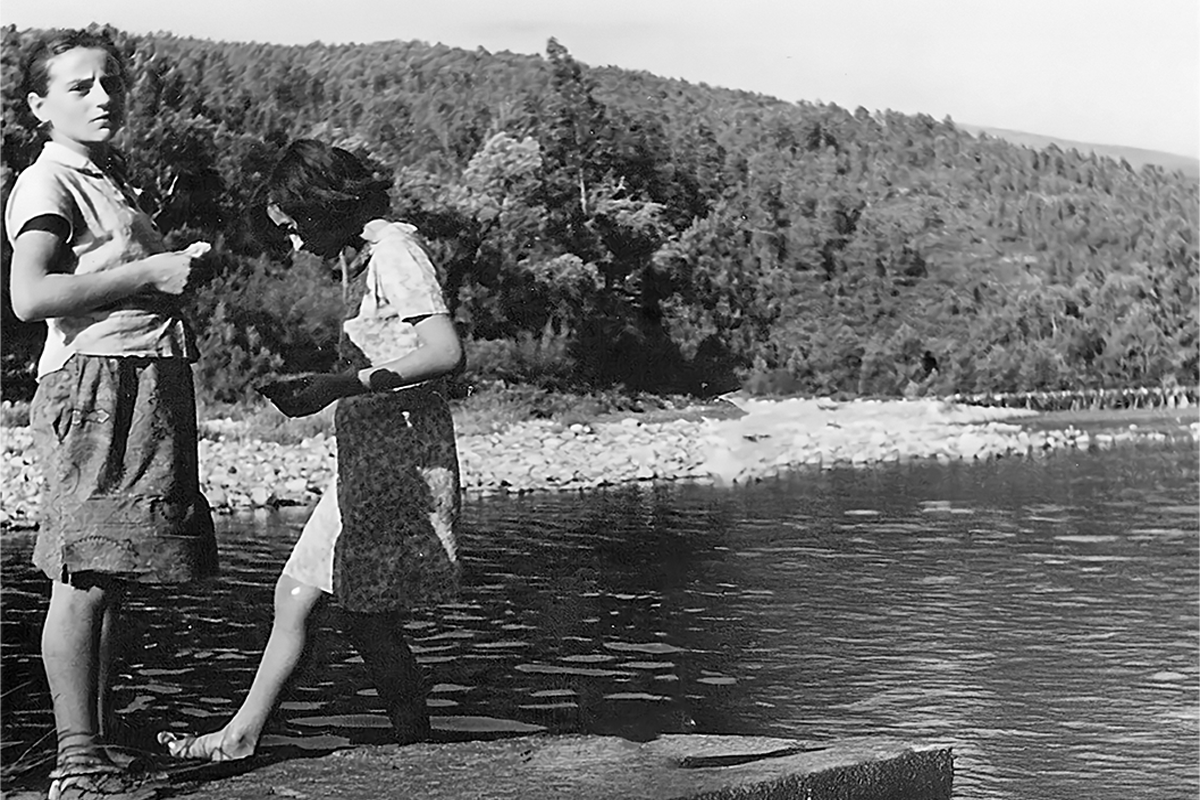
LISTENING TO RURAL YOUTH
Artist Residency
With
Adriana Lopes (PT), Leele Jürjen (EE), Luís Costa (PT) and Sanae Mazouz (MA/IT)
June 30th to 12th July
Várzea de Calde (Viseu, Portugal)
A production by Binaural Nodar with the support of the Municipality of Viseu, the Calde Civil Parish and the Italian art space Studio Florìda. An artist residency integrated in the Tramontana project, a network of cultural organizations operating in mountain contexts, co-financed by the Creative Europe program.
Being a child or young person in rural Portugal until half a century ago meant being part of a process of preparation for adult life that began at an early age and included a whole range of practical skills related to agriculture, livestock farming, domestic life, crafts, knowledge of the landscape, etc. Sociability was developed through participation in a dense body of traditions handed down from previous generations: rites of passage, games, dances, songs, etc., which provided an undeniable sense of belonging and inclusion in the group.
The social transformation of recent decades has profoundly shaken the model of rootedness among young people born in villages, as few young people decide to remain in the rural areas where they were born. Paradoxically, natural and rural landscapes are now sought after by many people, namely because these contexts have the potential to provide young people with a certain realignment between body and mind, particularly in the current context of growing levels of social isolation and other psychosocial issues.
In 2025, Binaural Nodar will celebrate the 20th consecutive year of its artist residency program, hosting three artistic projects between June 30th and July 12th that address aspects of the relationship between youth and rural contexts.
Adriana Lopes (Portugal)
Focused on forms of playful sociability, Adriana Lopes’ project seeks to collect old memories of play experiences and current ways of playing in the same rural space. On the one hand, it aims to revisit traditional knowledge and skills, while on the other hand, it explores the relationship between today’s rural youth and this craftsmanship of forms and ideas (what is coincidental, what is different).
Her academic training in anthropology has allowed Adriana Lopes to experiment with the ethnographic method in multimodality, articulating it with contiguous artistic practices — namely film, photography, and drawing. Taking the encounter as a premise for knowledge, the artist maps her body – archive in motion and in relation to the things she finds, in order to think, handle, and reflect on the world. Delving deeper into the ontology of theater praxis, Adriana Lopes also reflects on the problematic nature of representation in vehicles of expression—not only in dramatic activity, but also in writing and image.
Leele Jürjen (Estonia)
Leele Jürjen’s project explores the journey of a young woman struggling to break down the emotional barriers she has built to protect herself from society’s expectations and judgment. It also reflects the artist’s personal path toward openness, self-acceptance, and overcoming shame, emphasizing empathy over judgment. Deeply rooted in the indigenous cultures of Võro and Seto in southeastern Estonia, the artist’s work is shaped by a rich heritage passed down by her mother, Anna Hints, an acclaimed Estonian filmmaker and artist who was artist-in-residence at Binaural Nodar in 2010 and 2011. Fourteen years later, traveling alone as an artist to the same rural area of Portugal, Leele seeks to reconnect with her childhood memories of total creative freedom, transforming this experience of return into a therapeutic and transformative pilgrimage.
Leele Jürjen, born in 2006 in Tartu, Estonia, is a pioneering cellist and vocalist who combines classical training with traditional Estonian music. Beginning her musical journey with the kannel and cello under the guidance of renowned teachers such as Leho Karin and Reet Mets, Leele became the first cellist in the Traditional Music Department at Heino Eller Music College, where she explored folk music through her instrument in innovative ways. Deeply rooted in the cultural heritage of the Võro and Set peoples, which was passed down to her by her mother, Anna Hints, Leele has brought these sounds to life as a founding member of the folk trio Nova Lyre, blending ancient languages and contemporary arrangements.
Luís Costa (Portugal) and Sanae Mazouz (Morocco/Italy)
Two artists from different generations and backgrounds discover that, for different reasons, they both relate to the world of young people struggling with feelings of isolation and despair. The project by Luís Costa and Sanae Mazouz will possibly intertwine photography, drawing, video performance, and sound art, in pursuit of a multimodal reflection through honest experiences drawn from the dense inner world of some real young people. Equally inspired by the difficulties of migration and integration, the work emphasizes the experiences of young people navigating their emotions, cultures, and identities, while seeking to find understanding and empathy, proposing the hypothesis that some hope for regeneration can arise from unfiltered outcry and expression.
Luís Costa is a PhD researcher in artistic creation at the University of Aveiro and the School of Arts and Design (Caldas da Rainha). Since 2004, he has worked as a curator and programmer of contemporary artistic practices and as a sound and media artist. He is the founder and coordinator of Binaural Nodar since 2006. He is the author/editor of twelve books dedicated to sound/media artistic research and rural ethnography. Since 2007, he has been intensely involved in sound and audiovisual creation in rural contexts, through which he reflects on the specificities and landscape, social, and cultural changes of places.
Sanae Mazouz (born in 1999, in El Brouj, Morocco) is a multidisciplinary artist who works mainly in painting, photography, and video performance. Born in the Chaouia region of Morocco, where she lived until the age of nine, Sanae migrated to Italy to reunite with her father. With a high school degree in Industrial Chemistry, she is currently in her final year of a Fine Arts degree, specializing in Painting, at the Accademia Ligustica di Belle Arti di Genova, and regularly collaborates with the artistic organization Studio Florìda, located in the heart of Genoa’s old town.
Binaural Nodar is a organization supported by the Portuguese Republic – Culture | Directorate-General for the Arts.