
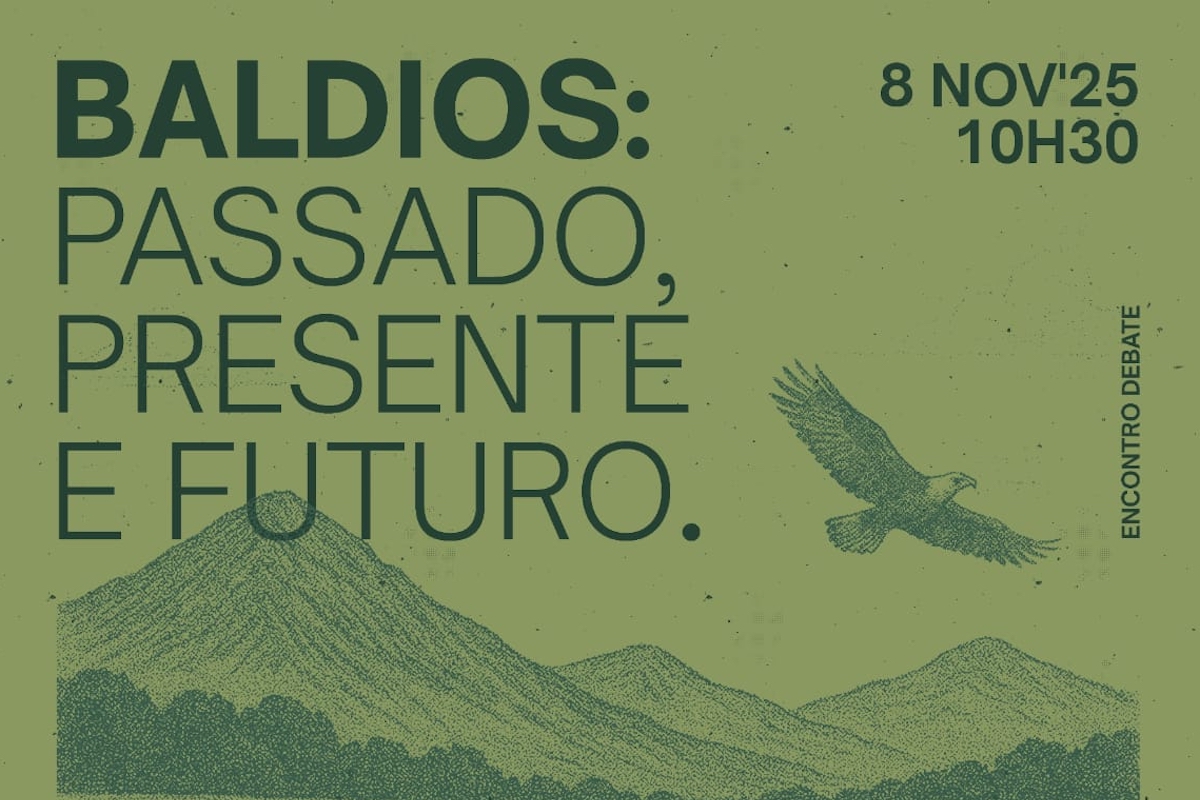
COMMON LANDS: PAST, PRESENT AND FUTURE
Meeting and Debate
8 November 2025 | 10:15 a.m. – 2:00 p.m.
Tendais Multipurpose Pavilion (Cinfães, Portugal)
As part of the Tendais Chestnut Fair and organised by the Association for the Defence and Promotion of Tendais, in collaboration with AEPGA, Binaural Nodar – Cultural Association, Palombar and the LIFE SOS Pygargus Project, a meeting will be held to reflect on the past, present and future of common lands.
Common lands are community spaces belonging to local populations, traditionally used for grazing, collecting firewood and other subsistence activities. During the Portuguese dictatorship, many of these lands were appropriated by the State and subjected to large-scale reforestation campaigns, which led to serious conflicts with the rural communities that depended on them.
After the Portuguese Revolution of 25 April 1974, with the approval of the 1976 Common Land Law, the people regained the right to collectively manage these areas.
However, common lands currently face new challenges. The depopulation and ageing of rural communities have led to the abandonment of several areas, with a decline in pastoralism and traditional management practices that ensured ecological balance. In many areas, common lands have been occupied by wind turbines or other infrastructure, generating revenues that do not always translate into sustainable investment.
Despite this, common lands continue to represent a collective heritage with enormous potential. They are strategic spaces for nature conservation, firefighting, population retention and the promotion of local economic models based on ecosystem services and community management.
The meeting aims to present case studies and ideas for a sustainable transition of these lands, creating a debate that seeks to value them as spaces for production and conservation, reflecting on the role and future of these community territories.
This transition includes dimensions of environmental protection and valorisation, cultural revitalisation, and creative exploration of heritage. Communal lands can be the starting point for a more diversified landscape and production models, integrating extensive grazing, natural regeneration and new forms of cultivation.
The landscape managed by communal lands is also a sensory, living and expressive heritage that can be documented and reinterpreted through art and research.
The meeting, taking place on 8 November, is the result of collaboration between different local, cultural and scientific partners, underlining the importance of a multidisciplinary approach to rethinking the future of common lands.
This is the first of several initiatives that aim to open up new perspectives on the common territory. The initiative, also linked to the Creative Europe Tramontana Network Project, marks the beginning of a cycle of meetings that combine nature, culture and innovation in the inland mountains.
Programme:
8 November 2025
10:15 a.m.: Reception of participants Tendais Multipurpose Pavilion
10:30 a.m.: Opening session
– Parish of Tendais
– Association for the Defence and Promotion of Tendais
11:30 a.m.: Series of presentations
– Luis Costa (Binaural Nodar)
– Ana Rodríguez (Sound Map of Uruguay)
– Miguel Nóvoa (Association for the Study and Protection of Donkeys)
– Joaquim Teodósio (Palombar – Association for the Conservation of Nature and Rural Heritage and Coordinator of the Life SOS Pyargus project)
12:30pm: Coffee break
1:00pm: Round Table
1:30pm: Closing Session
– Municipality of Cinfães
2:00 p.m.: Lunch
Registration, here.
Binaural Nodar is a cultural entity supported by the Portuguese Republic – Culture, Youth and Sports | Directorate-General for the Arts