
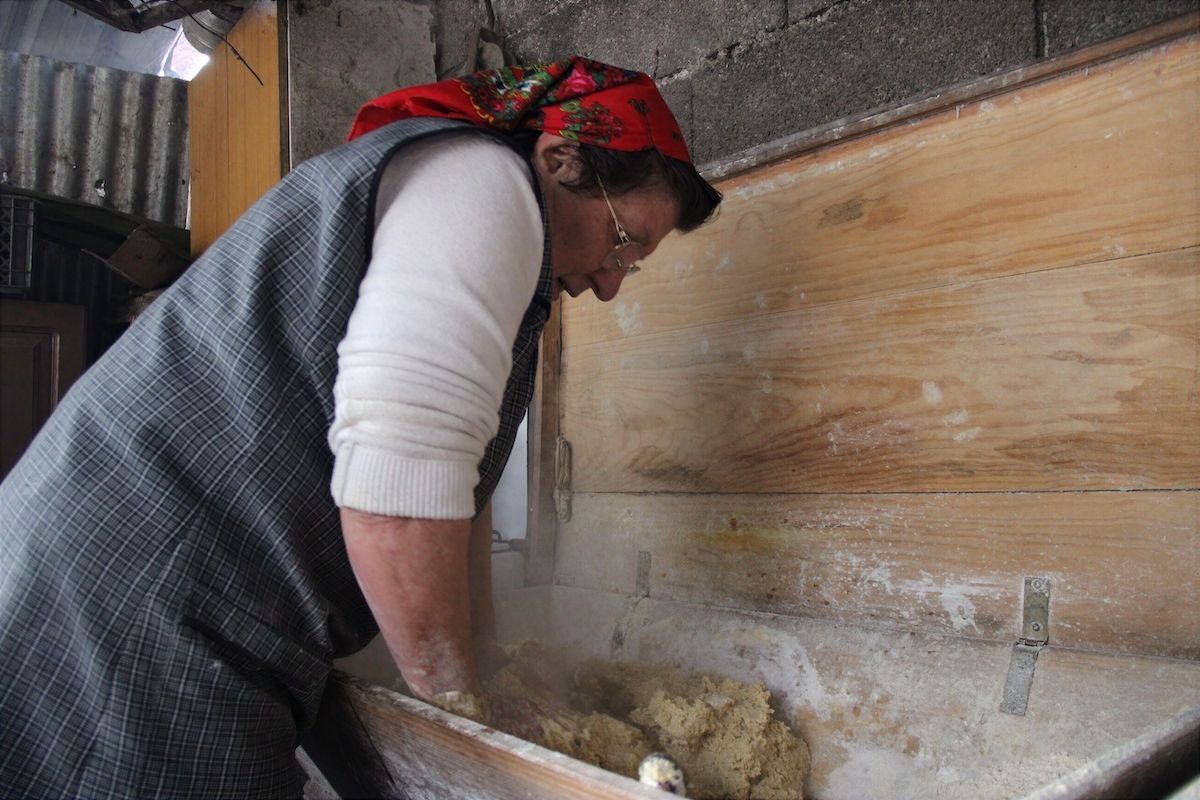
HOW DOES A VILLAGE FEED ITSELF?
Seasonal and generational variations in the food habits of Várzea de Calde.
A community residency
With Ana Rodríguez
From July 18th to August 18th, 2026
Várzea de Calde (Calde, Viseu)
Between July 18th and August 18th, Binaural Nodar is developing, in the village of Várzea de Calde (civil parish of Calde, municipality of Viseu), a new research and creation project dedicated to local gastronomy, in yet another partnership with the Uruguayan anthropologist and sound artist Ana Rodríguez. The project sets out to listen to and record the knowledge, gestures, and memories associated with food in the village, continuing a line of work that Binaural Nodar has been consolidating over recent years.
This foray into gastronomy follows other projects that had already addressed the theme of food indirectly, through different entry points: plants, in “Plantas Faladas” (2019); the journeys of emigration and return to the village, in “Ecos da Ida do Retorno” (2022); and a specific plant of the rural mountain world, in “A Carqueja no Quotidiano de Várzea de Calde” (2025). “How Does a Village Feed Itself?” now takes food as its central theme, seeking to understand how eating, cooking, and sharing a table shape the identity and community life of Várzea de Calde.
The work will seek to listen to the themes of food throughout the cycle of the year, as it was lived in the subsistence context of the rural communities of the Viseu region until about half a century ago, with a diet based on seasonal products, in a context of self-sufficiency. The aim is to reconstruct, through oral memory, the seasonal rhythms of growing and preserving food — what was eaten at each time of year, depending on what the land gave, and how enough was stored for the most difficult months.
This subsistence model, sustained by seasonal products and by what the village produced, would be progressively altered by phenomena that intersect and reinforce one another: globalization and the arrival of trade in the villages and nearest towns, which brought new products available all year round, no longer only in their season, and new forms of consumption; the social transformations driven by emigration, with the return of so many who left for Switzerland, France, Luxembourg, Canada, or Venezuela and brought back other habits and tastes; and, more recently, the influence of the media industry itself, which has come to shape people’s gastronomic desires, far beyond what the village produces and eats.
The project is also linked with “Landscapes, Voices, and Flavors of the Ukrainian Community in Viseu”, bringing together two communities that, at first glance, seem to have little in common, but that share a revealing symbolic link: Várzea de Calde is a Portuguese village where handcrafted linen continues to be worked, and in Ukraine linen is the national fabric par excellence, present in the famous embroidered shirts with traditional patterns worn, among others, by the Ukrainian community living in Viseu. It is from this dialogue between threads and flavors that a joint exhibition on the gastronomy of Ukraine and of Várzea de Calde is being prepared, to open at the end of the year at the Várzea de Calde Linen Museum.
“How Does a Village Feed Itself?” has the local partnerships of the Municipality of Viseu, the Calde Civil Parish Council, and the Association of Ukrainians in Viseu, and is part of the international project Tramontana Network, funded by the European Union’s Creative Europe Program. This framework gives the work carried out in Várzea de Calde and with the Ukrainian community of Viseu a dimension that goes beyond the local scale, placing it within a European network of cultural cooperation.
Binaural Nodar is a cultural organization supported by the Portuguese Republic – Culture, Youth, and Sports | Directorate-General for the Arts.