
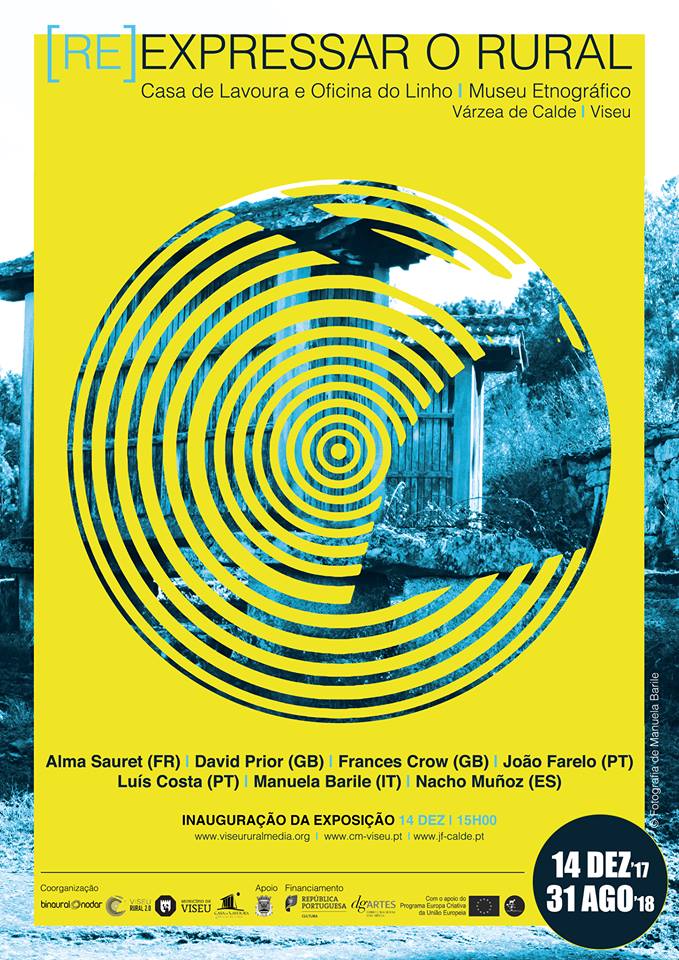
The exhibition “Viseu Rural 2.0: [Re]expressar o rural” (“Viseu Rural 2.0: [Re]expressing the rural”) opens on the 14th of December at 3:00 pm, at the Casa de Lavoura – Oficina do Linho de Várzea de Calde (Calde Parish Council, Municipality of Viseu), remaining open until the end of August 2018.
“Viseu Rural 2.0: [Re]expressar o Rural”
Multimedia Ethnographic Exhibition
From 14 December 2017 to 31 August 2018
Opening: 14 December at 3:00 pm
Location:
Casa de Lavoura e Oficina do Linho | Ethnographic Museum
Calçada do Eiró, Nº18 Várzea
3515-758 Calde
CO-ORGANIZATION
Binaural Nodar (Viseu Rural 2.0)
Municipality of Viseu (Casa de Lavoura e Oficina do Linho)
Part of the Creative Europe Réseau Tramontana project.
SUPPORT
Calde Parish Council
EXHIBITION CURATORSHIP:
Luis Gomes da Costa
EXHIBITION SPACE DESIGN:
Liliana Silva and Raquel Greenleaf
GRAPHIC DESIGN AND COMMUNICATION:
Liliana Silva
PRODUCTION:
Diana Silva
WITH WORKS BY:
Alma Sauret (France) / David Prior (England) / Frances Crow (England) / João Farelo (Portugal) / Luís Costa (Portugal) / Manuela Barile (Italy) / Nacho Muñoz (Spain)
The exhibition “Viseu Rural 2.0: [Re]expressar o Rural” is part of the Binaural/Nodar project, co-financed by the Municipality of Viseu under the Viseu Terceiro programme and by the European Commission, under the Creative Europe project (Tramontana network), constituting the final result of three years of intervention in an extremely active partnership with the Casa de Lavoura e Oficina do Linho de Várzea de Calde and the Calde Parish Council, which materialized in dozens of video and sound recordings linked to the flax cycle, carried out with local residents, and to various agricultural works and traditional trades, in a wide series of soundscape recordings of the rural character of the parish, in hosting several creative works developed in the parish by national and foreign artists and around twenty educational activities for sound discovery of the collection of the Casa de Lavoura e Oficina do Linho.
The Viseu Rural 2.0 project began its intervention in 2015 and this year has its third edition, characterized by a great diversity of encounters with the population of the rural parishes of Viseu, educational activities, intergenerational memory-activation encounters, artistic residencies, sound and media creations, documentation and archiving on a specific web platform, an international electroacoustic music competition based on the archive, and sound and multimedia exhibitions. The essence of the Viseu Rural 2.0 project relates to a daily, non-sporadic closeness with the populations of the rural world, an aspect that has characterized Binaural/Nodar’s work for more than a decade, with the association acting with a very special empathy for that world, not unrelated to the fact that the association’s board is made up of children of the rural world who document and express their own heritage, as an innovative and contemporary legacy, neither nostalgic nor closed to the world.
The exhibition “Viseu Rural 2.0: [Re]expressar o Rural” is made up of two main groups of works: on one hand, a set of sound and video works that will become part of the permanent collection of the Casa de Lavoura e Oficina do Linho, since they complement and add new meanings, sensoriality and interactivity (for example, sound-based) to that permanent collection, and, on the other hand, a series of contemporary artistic creations specifically conceived by national artists based on the extremely rich heritage of the parish of Calde.
1. Works conceived for the permanent collection of the Casa de Lavoura e Oficina do Linho:
Binaural/Nodar (PT):
“O Toco de São Francisco” (2017) (sound installation)
A sound evocation, simultaneously of the importance of ox carts, which were, until a few decades ago, the main means of transporting agricultural loads in the villages of the Beira region, and also of the traditional festival of the village of Várzea de Calde, the “Toco de São Francisco”, an ancestral initiation ritual, in which dozens of young unmarried men would, in the late afternoon of the 3rd of October each year, cut down trees on the hillside without the owners knowing, to load them onto an ox cart and drag the loaded cart themselves to the square of the Chapel of São Francisco, where they would light a huge bonfire and, between food and drink, socialize throughout the night. This ritual is still practiced today, with some adaptations resulting from the passage of time and the existence of fewer young people in the village.
Recorded on the 3rd of October 2016 by Luís Costa
“O Ferreiro de Paraduça” (2017) (audiovisual installation)
An interview and demonstration with the last blacksmith forger of the Parish of Calde, Mr. César de Almeida Vilar, resident of the village of Paraduça. A craftsman, son and grandson of blacksmiths, who still works iron or other metals, forging it, that is, shaping it hot or cold in order to give it the shape of the desired object (hoes, ploughs, mattocks, sickles, scythes, horseshoes, ox-cart wheel rims, etc.). Hence the expression wrought or hammered iron for the object made by the blacksmith forger. This forge in Paraduça still uses the age-old process of direct ore reduction by means of charcoal in a small furnace. This furnace is about one metre high, where the air is blown by means of a leather bellows, in this case operated manually, but which could in other cases be operated by hydraulic or animal traction.
Recorded on the 9th of June 2017 by Luís Costa
“Fogo Lento” (2017) (sound installation)
The traditional Beira kitchen was the true epicentre of the nighttime communal life of the villages, particularly during winter. An earthen floor, an oven for baking bread or roasting some meat, a set of iron pots of various sizes, all with three legs, used on the ground with fire fuelled by pine needles, pinecones and firewood from the hillside. Several benches and stools surrounded the fire, for family and friends to warm themselves. During the week, with little abundance, an onion broth or cabbage with beans would suffice, occasionally accompanied by a little pork, bacon or, when luckier, a meat or blood sausage. The kitchen is also directly linked to the flax cycle, since it was in these same kitchens, on long winter nights, that women spun flax thread with their distaffs and spindles, while exchanging views, singing or recalling old stories of inhabitants long gone in the mists of time.
“Fogo Lento” (“Slow Fire”) sonically recreates a traditional kitchen of the village of Várzea de Calde from 50 or 60 years ago, thus adding additional meanings and sensorialities to the pieces and furniture that make up the kitchen room of the Casa de Lavoura e Oficina do Linho.
Composition by Luís Costa based on recordings made between 2015 and 2017 in Várzea de Calde
“Várzea de Calde, uma aldeia tecida a linho” (2017) (documentary)
Among the myriad villages that make up a parish, a municipality or a region, some stand out for certain characteristics, despite the similar culture they share. A village with the Vouga river at its feet and with vast sunny areas for drying cereals, aptly named Várzea de Calde, has since time immemorial had the ideal characteristics for growing flax. In other words, among other factors, it is the very geomorphology of the landscape that induces some villages to specialize in certain arts and traditions. This documentary, based on collections made in 2016 and 2017, follows, in parallel, the art of the flax cycle and the life story of the group of women who currently dedicate themselves to it in Várzea de Calde. A palimpsest of landscapes, knowledge, labour and memories of brave women who do not give up continuing a tradition that literally defines a village.
Duration: 15 minutes (short version).
Direction: Luís Costa
Ethnographic research: Luís Costa
Video collections: Luís Costa and Manuela Barile
Sound collections: Luís Costa and João Farelo
Audio and video post-production: Luís Costa
“Vento, água, terra” (2017) (sound installation)
The whole context of the village of Várzea de Calde would not exist without a set of primordial elements of nature that give life and that feed human activity. “Vento, água, terra” (“Wind, water, earth”) is thus a tribute to these forces, present since the beginning of time, in the form of a sound composition that condenses the multiple natural nuances that surround the village, which also serves the function of welcoming visitors to the exhibition.
Sound composition by Luís Costa, based on recordings made in the village of Várzea de Calde between 2015 and 2017.
“Concerto para teares” (2017) (audiovisual installation)
The flax process ends at the loom, a true creative canvas and necessity of the ancients and, at the same time, final proof that the magic of a whole long and arduous process is completed with fabrics that serve multiple purposes. However, each loom is, at the same time, unique. No two are alike, as they are built according to the spaces and wishes of the weavers and sound different depending on the hands that operate them. This “concerto para teares” (“concert for looms”) is thus a sound and visual tribute to the appropriation by each family of the flax looms of Várzea de Calde.
Audiovisual composition by Luís Costa, based on recordings made with the weavers of Várzea de Calde between 2015 and 2017.
2. Contemporary Works based on the heritage of the parish of Calde:
Manuela Barile (IT)
“O Sacrário do Milho Milagroso” (2017) (artistic installation)
Usually built of wood and stone and placed on top of large, tall pillars, the corn cribs (canastros) represent true works of folk art with a high magical and symbolic charge. They are shrines where, on the Iberian Peninsula, people stored corn, an essential food for people and animals for the whole year, and, as such, were formerly marked with a cross that blessed, protected and safeguarded the corn from curses. Nowadays the corn cribs are becoming increasingly empty, due to the industrialization of the corn-growing process and the abandonment of villages. Time passes inexorably over these isolated lands. Corn seems condemned to lose its sacred home forever. But there is no lament. Within us will remain the memory, the remembrance, the sign, the emblem of corn. Inside the corn cribs, the presence of this miraculous corn that lit up past generations will continue to light up future generations with new forms and meanings.
Manuela Barile. Artistic Director of Binaural/Nodar. Italian intermedia artist who has lived in the district of Viseu since 2006. She develops projects based on places in rural regions, working in close contact with residents and taking into account specific aspects of the territories such as their geography, memory, architecture, symbolism and rituals deposited as indelible signs on the land. Trained in vocal performance and audiovisual creation, she began a personal journey in 2000 with presentations across much of Europe. About her work, Edições Nodar published in 2014 the catalogue + DVD “O Sentido da Dor: Duas Obras de Manuela Barile” (“The Meaning of Pain: Two Works by Manuela Barile”), with her own texts and those of curators, anthropologists and theologians.
João Farelo (PT) + Alma Sauret (FR) + Luís Costa (PT)
“O tear mudo” (2016) (sound installation + photography)
“O tear mudo” (“The Silent Loom”) is a sound and musical performance next to an old, no-longer-used loom, forgotten in an outbuilding at Largo de São Francisco in Várzea de Calde. Luís Costa and João Farelo manipulated objects found in the outbuilding (tools, clothing items, cupboards, wooden benches, etc.) while Alma Sauret improvised with her alto saxophone, thus creating a musical elegy for a loom that holds long memories of all the pieces woven on it over decades, perhaps over more than a century.
Alma Sauret (b. 1993 in Valence, France) is a young sound artist and experimental contemporary musician. She explores various pataphysical approaches in music and sound. She is currently finishing her Master’s dissertation in Art at the Grenoble School of Art and Design, France, during which she developed an important body of musical/sound works.
João Farelo (b. 1981) is a Portuguese sound and visual artist, holding a Master’s degree in intermedia visual arts from the University of Évora, with his dissertation supervised by Pedro Portugal. His artistic work has sought the encounter between the following focuses of interest: walking, the invisible, silence, journey; and the becoming of elements of the territory and landscape.
Luís Costa (b. 1968) is the coordinator of Binaural/Nodar (Viseu Dão Lafões, Portugal) and a sound researcher and educator who seeks in his works senses of questioning and perplexity arising from the passage from ancestrality to modernity in rural or industrial contexts. “Memória Sonora da Cortiça”, “Concerto para Clarinete e Nodar”, “São Pedro do Sul: Novas Escutas Rurais”, “La Tradition Balbutiée”, “Campanologias Beirãs” or “Lendas Sonoras de Lafões” are some of his sound works, published in book, CD or online, or exhibited in the context of concerts, sound and multimedia installations across much of Europe.
David Prior (GB) + Frances Crow (GB)
“To Intercession” (“Intercessão”) (2015), Sound Installation
Bells have a unique status among man-made sound objects. Not only are they one of our earliest classes of instruments, but their use and influence spans almost every culture and, in many of them, the bell remains an enduring and significant sound icon, both in religious and civic life today. Just as prayers are inscribed on the metal of bells, being cast up to the sky when they are rung, bells have also been understood since the early church to represent the voice of God. In “To Intercession”, the voices of the women interviewed by Binaural/Nodar in the Parish of Calde (municipality of Viseu) are transmuted into bell tones, which are reproduced through four small speakers mounted on brass bars — tiny transducers, mediating one type of energy into another.
Liminar is a partnership between architect Frances Crow and sound artist and composer David Prior. They began working together in 1996 and formalized their working partnership in 2003. Their work focuses on exploring the relationship between sound, listening and environment. Starting with a residency with Binaural/Nodar in 2013, the artists have produced a series of works exploring different aspects of bells and their relationship with culture. In “Desta Paróquia” — an installation and a short film — they focused their attention on the role bells play in shaping territory and on the notion of parish as a zone of protection and jurisdiction defined by sound. In “Report” and “289ms Away” they focused on the role of bells in our perception of time. More recently, with their piece “Transient Parish”, they created a temporary bell tower, creating a parish for the period of just one day.
Nacho Muñoz (ES)
“Novos Cantares de Várzea de Calde” (2016) (sound installation + photography)
Novos Cantares de Várzea de Calde (“New Songs of Várzea de Calde”) is the result of an artistic residency by Galician composer Nacho Muñoz, who sought to create an unlikely synthesis between the traditional songs linked to the flax cycle performed by the Grupo Etnográfico de Trajes e Cantares do Linho de Várzea de Calde and the introduction of two types of non-disruptive elements: on one hand, electronic sounds performed by the author and, on the other, percussion sounds performed by the singers of the traditional group with the help of various everyday objects. The final result constituted an exercise in musical hybridity, in an unstable balance between tradition and contemporaneity.
Nacho Muñoz is a Galician musician, pianist and composer who has worked for many years in the fields of sound art, opera, performance, interactive systems and sound in public space. Several of his musical works have been released on the labels Alg-a Label (Galicia), Crónica Electrónica (Portugal), Xylem Records (United Kingdom), Modisti (Spain) and Haze (Greece), and he has presented his works on stages in Europe, Africa and Latin America. He is also linked to the Alg-a network of artists, the Orquestra de Música Espontânea da Galiza (OMEGA), and was director of the Alg-a Lab Artistic Residency Centre in Vigo.


