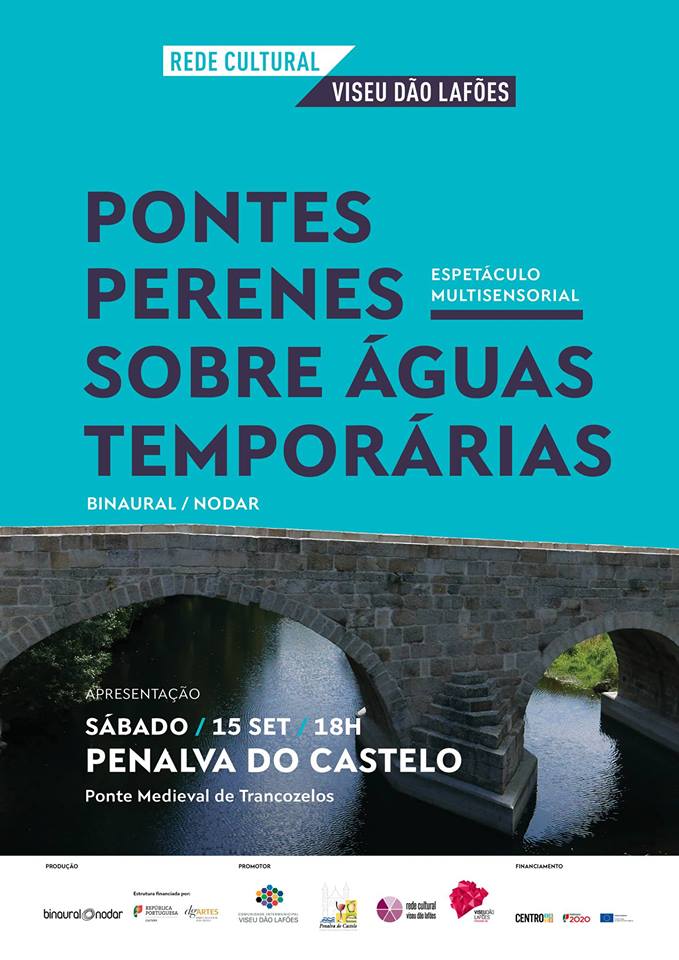
“Pontes perenes sobre águas temporárias” (“Perennial Bridges over Temporary Waters”)
A multisensory performance by Binaural Nodar
Medieval bridge of Trancozelos (Penalva do Castelo)
Saturday, 15 September at 6:00 pm
Geographic coordinates: 40.658379, -7.704226
Artistic direction: Luís Costa
Sound composition: Rui Costa
Set support and audiovisual documentation: Liliana Silva
Participation: Banda Musical e Recreativa de Penalva do Castelo and Rancho Folclórico de Penalva do Castelo.
“Pontes perenes sobre águas temporárias” is a Binaural/Nodar project, in the form of a multidisciplinary concert of multisensory and anthropological activation of bridges in the Viseu Dão Lafões territory, using the whole surrounding context, the architectural characteristics of the bridges and local stories to generate unique, unrepeatable experiences.
The first performance of “Pontes perenes sobre águas temporárias” will take place on the banks of the Dão river next to the bridge of Trancozelos (parish of Trancozelos, municipality of Penalva do Castelo) on Saturday 15 September at 6:00 pm, in the context of which the sounds of the surrounding landscape will be activated, local stories of the bridge will be told, and a tribute will be paid to the strong musical tradition of the municipality, with the presence of local musicians, including members of the Banda Musical e Recreativa de Penalva do Castelo and the Rancho Folclórico de Penalva do Castelo.
The Dão river is a typical Beira river, rising in the plateaus of Trancoso and Aguiar da Beira and flowing into the right bank of the Mondego river, running from Northeast to Southwest, crossing or bordering the municipalities of Aguiar da Beira, Penalva do Castelo, Mangualde, Nelas, Viseu, Carregal do Sal, Tondela and Santa Comba Dão. In its valley, a high-altitude area with granite soil, lies the Região Demarcada do Dão, known for producing the renowned wines that have raised the winemaking of the Viseu region to the highest levels of recognition.
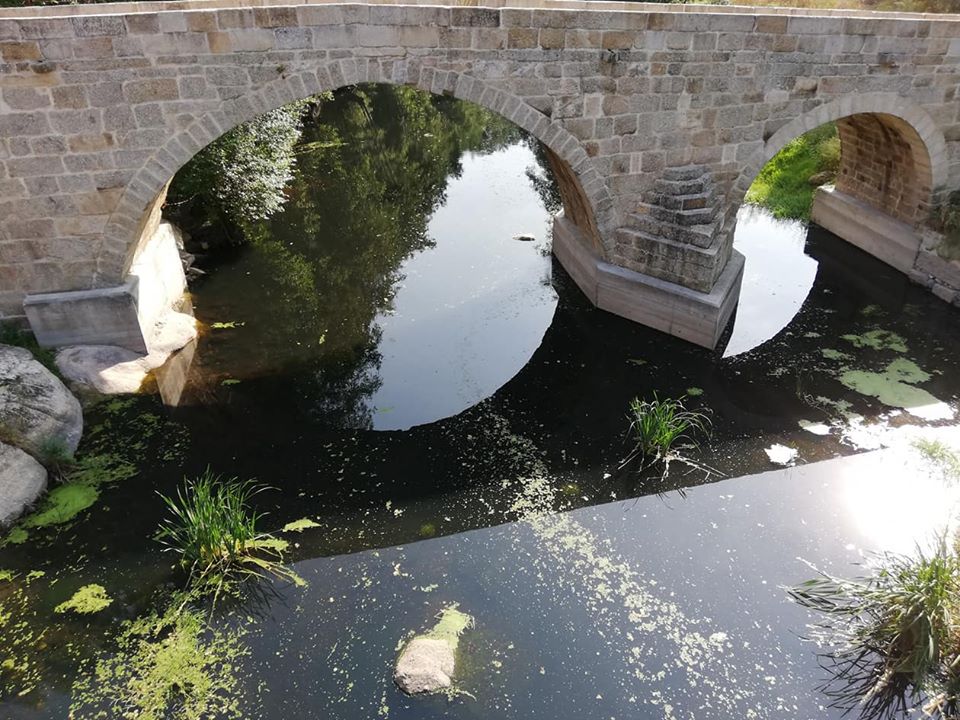
The bridge of Trancozelos is a bridge of medieval origin, entirely built in granite, whose deck rests on two perfectly rounded arches supported by a pillar protected by a triangular cutwater on the upstream side. The deck has a flagstone pavement, retaining, in some areas, its full stone parapets, with two gargoyles appearing downstream for rainwater drainage. Extending a short distance to one side is the probable stretch of the old road. On the northwest side of the bridge stands a niche made of exposed granite ashlar blocks bearing the following inscription:
MANDOV / FAZER . O . S . D . N . EESTE NIXO THOME / MELO DE CAMPOS FALCAM DE LIZEI / ÇARGENTO MOR DESTE CONCELHO / 1735 / ESMOLAS P. AS / MISÃS DAS ALMAS
We thus know that the niche was commissioned by Tomé Rebelo de Campos Falcão, of Lizei, Sergeant-Major of the municipality, in 1735. The alms were for masses for the souls.
It is known that on 9 January 1729 the master stonemason Pascoal Gonçalves Guerreiro took on, in partnership with António Ribeiro, the construction of the bridge, which was not completed by 1732 due to a lack of craftsmen, who had been requisitioned for the works at the Mafra Convent, according to the parish priest of the time.
The bridge provided access to the left bank of the Dão, serving not only the Monastery of Santo Sepulcro, but also the villages of Trancozelos and Trancozelinho and access to the parish of Germil e Real, and from there to the royal road Viseu-Guarda, which passed through Quintela de Azurara.
The founding of the Monastery of Santo Sepulcro, the first of this canonical and military order in the Iberian Peninsula, is due to the initiative of D. Teresa and dates back to the beginning of the nation. The monastery and the settlement, which then became known as Vila Nova do Santo Sepulcro, grew over the following centuries, benefiting from the assets that were donated to it. This positive cycle was followed by another, of decline, which led the monastery to become dependent on the Comenda de Sezures, which, in 1492, still maintained its connection to the second house of the Order of the Holy Sepulchre, based in Águas Santas. However, a papal bull of 1489 had already ordered the union of the Monastery of Santo Sepulcro with the Order of Malta, which is why several crosses, characteristic of these knights, can be seen in the old monastic enclosure. With the extinction of the religious orders in 1844, the property was acquired by the Albuquerque family, of the Casa da Ínsua.
https://www.facebook.com/binauralnodar/videos/2153337251600087/