
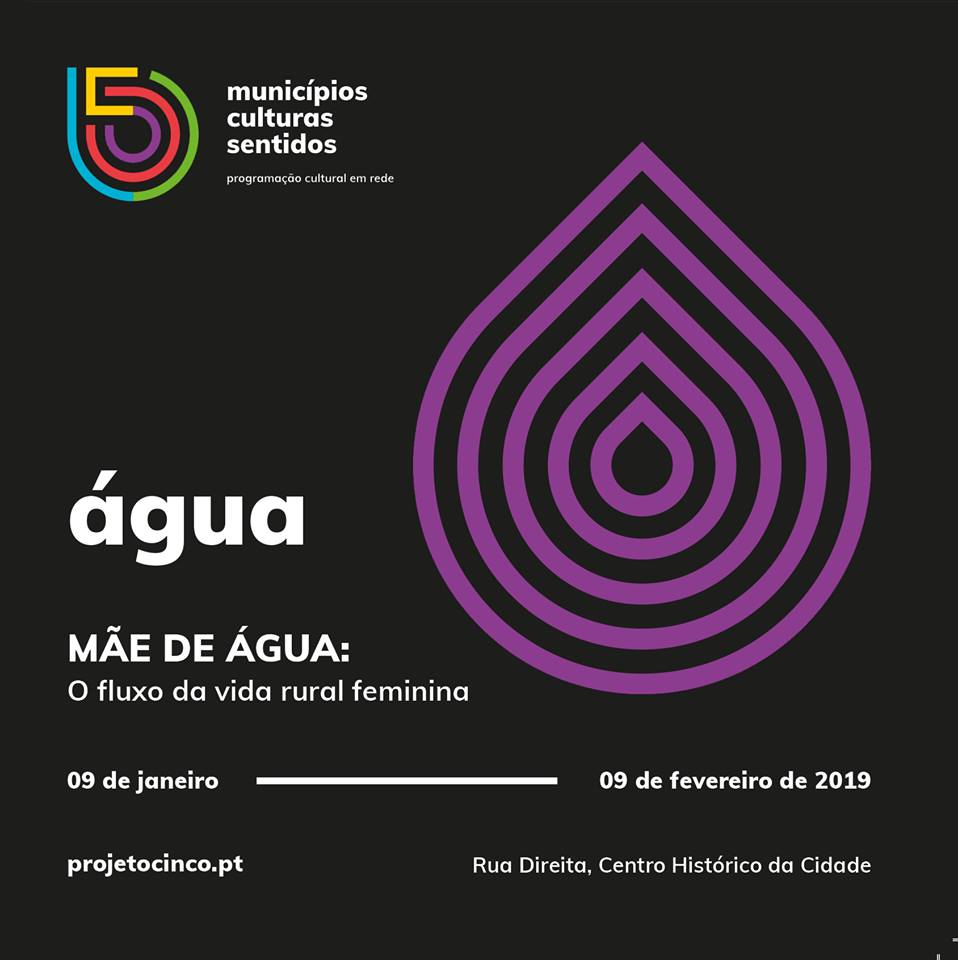
“Mãe de Água: O fluxo da vida rural feminina” (Mãe de Água: The Flow of Rural Women’s Life)
An ethnographic and multimedia journey
January 9 to February 9, 2019
Monday to Friday, from 2:00 pm to 6:30 pm
Saturdays from 9:30 am to 12:30 pm
Historic centre of São Pedro do Sul (Municipality of São Pedro do Sul)
A Binaural Nodar production
Original idea by Luis Gomes da Costa
Artistic interventions by Luis Gomes da Costa, Manuela Barile, Liliana Silva and Tiago Pereira.
Artistic support and production direction: Diana Silva
Ethnographic sound and video recordings from the Binaural Nodar Digital Archive (http://www.archive.binauralmedia.org) produced by Luís Gomes da Costa, Manuela Barile and Ana Rodríguez.
Ethnographic and photographic materials from the municipalities of São Pedro do Sul, Águeda, Idanha-a-Nova, Óbidos and Lousã.
Since archaic civilizations, women have been associated with fecundity, fertility and the origin of life. These elements are often represented by aquatic symbolism, evoking transformation, purification and vital force itself. Water is thus understood as the starting point for life itself, without which nothing grows, nothing is fertilized. At the same time, water is a symbol of healing, or spiritual cleansing (as in baptism, where “holy water” is literally a “blessing” that washes away sins).
On the other hand, in rural territories, water has always been the fundamental element for the settlement of communities in certain places: the water of springs, fountains, streams, rivers, washing places, mills, fulling mills, irrigation systems, thermal springs, etc.
“Mãe de Água: O fluxo da vida rural feminina” is an ethnographic and multimedia proposal in public space that will animate an important part of the most historic area of São Pedro do Sul, consisting of a river of stories running through the rural lives of the territories included in Projeto Cinco, in the form of a series of “scenes” that combine audiovisual elements, objects and interactivity, representing various stages of rural women’s lives, always with water as a common thread.
The intervention is intended for the enjoyment of local audiences, tourists and educational communities, and comes with a map proposing a route marked with explanations of the meaning of each element of the intervention.
Despite its multimedia elements, the intervention aims to be simple and emotional, in order to capture the attention of all kinds of audiences.
