
WHAT CAN RURAL PLACES SAY TO EACH OTHER?
Presentation of artistic research between Viseu Dão Lafões (Portugal) and Abruzzo (Italy)
March 1st, 9:00 p.m.
Penna Sant’Andrea (Abruzzo, Italy)
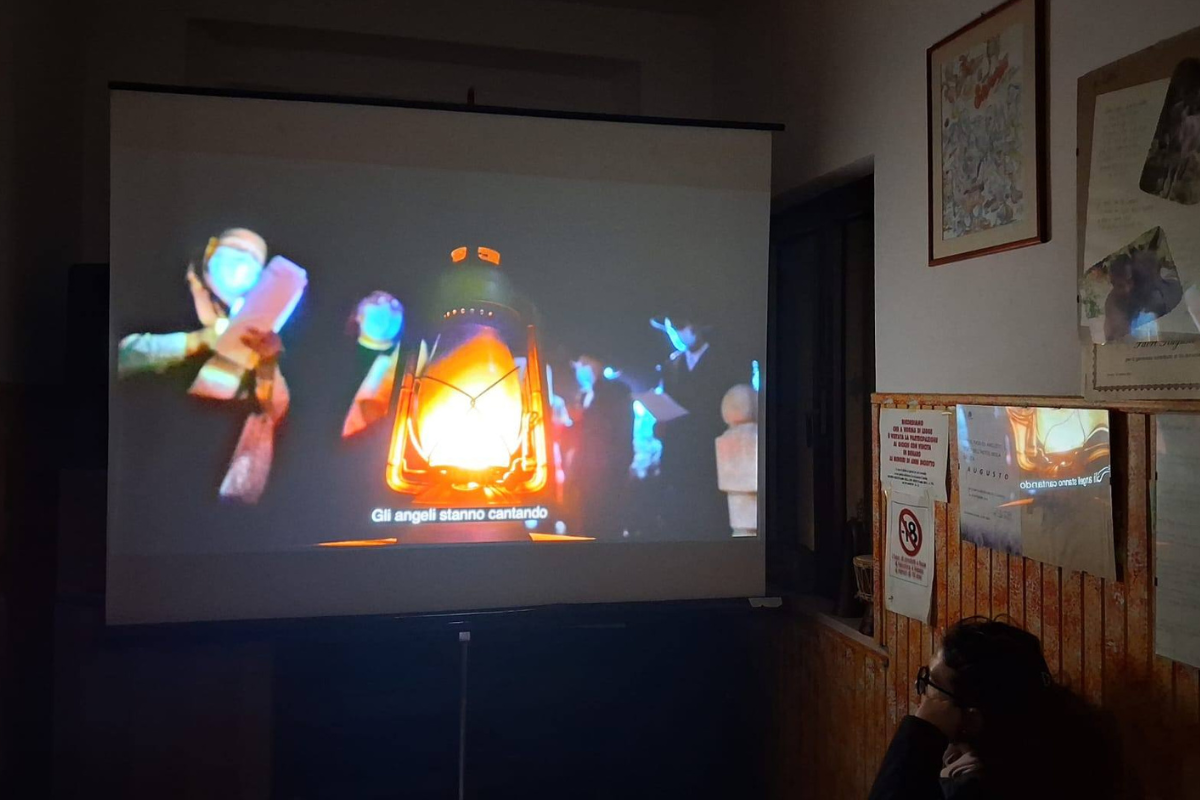
Last Saturday, at Bar da Augusto, “Arjotvene nnà tenote na case?” was presented in Penna
Sant’Andrea (Abruzzo, Italy), the result of artistic research by Luís Costa, coordinator of the Binaural Nodar association, carried out in mountain landscapes and communities in the Italian region of Abruzzo, in a co-production between Binaural Nodar, Bambun APS, and Centro Studi Don Nicola Jobbi. This research is also part of the Tramontana network and is co-financed by the European Union’s Erasmus+ program.
In the context of this doctoral research, Luís Costa explored the empirical, sensory, and imaginary relationships between rural locations in the Portuguese region of Viseu Dão Lafões and the Italian region of Abruzzo, through a series of four new audiovisual essays that problematize the concept of the “third place.”
With this research, carried out in collaboration with two Portuguese research centers: ID+ (University of Aveiro) and LiDA (School of Art and Design, Caldas da Rainha), the nine audiovisual essays included in Luís Costa’s doctoral research are now complete, reflecting various aspects of the relationship established between rural locations, such as popular religiosity, mountain flora, textile crafts, the relationship between humans and animals, irrigation systems, among others.
The supervisory team for Luis Costa’s doctoral research is composed of Prof. Graça Magalhães, Prof. Susana Duarte, and Prof. Sérgio Eliseu.
Photographs by Gianfranco Spitilli.
Works presented:
The Time of the Eternal Garden
Poggio delle Rose (TE), Italy, and Gafanhão (Castro Daire), Portugal
The Animals of Creation
Contrada Li Massimuccë (TE), Italy, and Raso (Castro Daire), Portugal
Weaving
Campotosto (AQ), Italy, and Várzea de Calde (Viseu), Portugal
The Night in Common
Penna Sant’Andrea (TE), Italy, and Negrelos (São Pedro do Sul), Portugal
Luís Costa would like to express his special thanks to everyone who helped or was interviewed in the context of the field research for these four works: Gianfranco Spitilli, Domenico de Teodoro, Assunta Perilli, Augusto Fabri, Valentino Salini, Annunziata Buonasorte, Angelo Pavone, Giovina Canulli, Arlindo Pereira, and Cátia Silva.
Binaural Nodar is a cultural structure supported by the Portuguese Republic – Culture, Youth and Sports | Directorate-General for the Arts.


