u?ltima sai?da.jpg

Since the announcement of the end of Aldeias Sonoras’s (”Sound Villages”) first cycle, in December 2009, the Portuguese press has recognized the project as one of the most interesting to happen in Portugal throughout last year:

  • The daily newspaper “Público” dedicated a full page article to this educational project on December 12th, 2009.
  • Carlos Pinto Coelho, a veteran of cultural journalism in Portugal interviewed Binaural’s director Rui Costa about the project and this emission was broadcasted in about 90 Portuguese and Spanish radio stations between January 18th and 24th, 2009.
  • One of the most recognized Portuguese web portal’s aeiou, has highlighted the project during the last week of 2009.
  • Fernando Alves, a talented radio chronicler of Portuguese life, has dedicated a brief but magnificent emission, broadcasted on January 26th, 2010 at TSF’s “Sinais” program.

Here is the audio of both the interview with Rui Costa and Fernando Alves’s chronicle about “Aldeias Sonoras”:

 
icon for podpress  Aldeias Sonoras @ Agora Acontece Radio Show: Play Now | Download

 
icon for podpress  Aldeias Sonoras @ TSF's Sinais Radio Show: Play Now | Download

LOCUS IN QUO
Three audio/video installations by Manuela Barile

Cultural Forum of Cerveira (Vila Nova de Cerveira, PT)
18 December 09 – 16 January 10

Opening on 18 December at 9.00 p.m. (with a live performance by the author)


Locus in Quo – which means “the place where something happens” – is the general title the artist gave to a body of works based on a particular theme: the sense of places. The project consists of three audio/video installations (Pesa, Cá and Birdsoundcage) and a concert performance (Oikos). These components function both as interconnected, independent works and, as a single cohesive work.


Pesa (“nest” in Estonian) is a three-channel video installation conceived in response to a site-specific performance that Manuela Barile developed at Moks, an artist residency in Estonia between September and October 2008. It consisted on building a nest in several places where the artist felt a sense of belonging (the abandoned house, the abysses of the lake, the rock near the pond, etc). Pesa describes the approach of a person who leaves with sadness and deep awareness the place to which he is attached, to set off in search of his new “home.” Pesa is a project dedicated to the house, to the house of our childhood and to all the houses we have abandoned during our life. It is an interrogation on the feeling of abandon and melancholia. The sound composition is made by: sounds of the performer’s voice recorded live in places where the nests were constructed and then abandoned, field recordings made in the places described above and an abstract of an Estonian traditional song about the theme of the abandon.


is a two-channel video installation developed as a consequence of the artist travels since March 2009 in search of abandoned villages in the region of São Pedro do Sul (Portugal), where she is been living since 2006. The abandoned villages are places with a strong identity, are places alive even if they are uninhabited, even if the nature has gradually absorbed them. They are places still alive because full of memory. They are a bridge with the past … our past. The artist aim was to trace, catch and interrogate the signs of life and memory where everything seems over. Tracking the signs of memory means for her to take back our roots to reconnect us to a sense of authenticity that is being extinguished. The sound composition is made by: sounds of the performer’s voice recorded live in the abandoned villages using a binaural microphone; sounds of the abandoned villages; sounds of other villages (like the sound of a celebration in a public square, of a window opening and closing); abstracts of traditional songs of the region where there are the abandoned villages (S. Pedro do Sul, Portugal).


Birdsoundcage is a sound and video installation. Is a cage for birds recreated through the medium of sound in an empty and sterile room. Inside of it, there is a body flopped to the ground, that in order to survive decides to make a custom-made cage made by prostheses. The prostheses are obtained setting white-patched twigs of wood on her lower and upper limbs. The organic matter, with which the prostheses are made, is the rest of a nest, a place of the past that no longer exists.


Credits

Original Idea and Artistic Director: Manuela Barile
Vocal Performer and Sound Compositions: Manuela Barile
Field Recordings: Manuela Barile, “Birdsoundcage” – Duncan Withley (England)
Video Footage and Editing: Manuela Barile
Camera Assistants: “Cá#1” João Rodrigues & Luís Costa, “Birdsoundcage” Luís Costa
Speakers: “Pesa” – Evelyn Müürsepp (Estonia)
Singers: “Pesa” – Anna Hints (Estonia), “Cá” – Traditional singers from the S. Pedro do Sul region (Portugal)
Sound Post Production: “Pesa” and “Cá” – Rui Costa (Portugal
Multichannel Audio Composition: “Birdsoundcage”- Duncan Whitley
Wardrobe: Creazioni Ranieri (Italy), Brazukinha (Brazil)
Artist Residencies: Moks (Estonia) and Nodar Artist Residency Center (Portugal)
Production: Luis Costa & Carina Martins (Binaural)
Support: Portuguese Ministry of Culture

Pesa #1 @ Lecce, Italy

On December 5th, 09 @ 7.00 p.m, Manuela Barile presents her video “Pesa #1″ in the context of “Off Minute – IV International Festival of Video Art and Digital Cultures” that happens at Primo Piano Living Gallery in Lecce, Italy.

Pesa #1 is part of a video installation conceived in the context of Manuela Barile’s art project “Locus in Quo” from a site-specific performance conducted during a residency at MokS, Estonia in October 2008.

OFF MINUTE, LECCE

Abbiamo Fatto 30, Facciamo 31

La Scatola  Manuela Barile & Rui Costa  (17)

Zepelim, an experimental radio show from Coimbra’s University Radio, recently proposed Manuela Barile a 55 minute radio piece. She took the opportunity to conceive an aural reflection on her artistic and personal life, where some of her recent pieces were mixed with sounds from her dearest ones and from some of her influences in art such as Carmelo Bene, Andrei Tarkovski, Maria Callas, Pier Paolo Pasolini, Anna Magnani, etc.

Listen to “Abbiamo Fatto 30, Facciamo 31″:

 
icon for podpress  Abbiamo Fatto 30, Facciamo 31: Play Now | Download

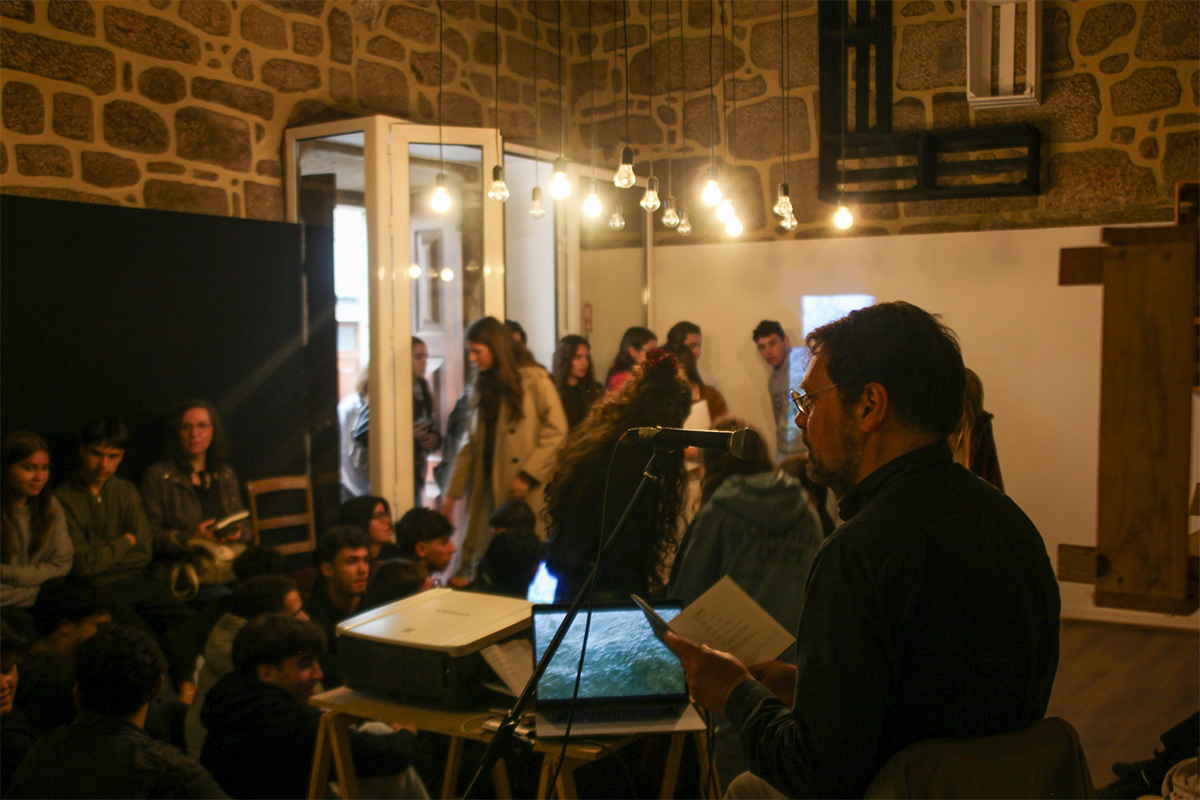
Aldeias Sonoras”, an educational project directed by Binaural which consists in the a sound gathering and mapping of Portuguese rural areas will end its first cycle with a public event at São Pedro do Sul’s municipal auditorium, the head of municipality of the region where the project was developed  during the last 9 months and which involved the participation of circa 20 students from the local secondary school.


Event’s Program:

4.00 p.m. – 5.00 p.m.: Talk with the authors and participants in the “Aldeias Sonoras” project.
5.30 p.m.: Screening of a documentary film directed by Luis Costa from footage shot throughout the field recording sessions in rural villages around S. Pedro do Sul
6.30 p.m.: Opening of a sound and photo exhibition.


Organization: Binaural/Associação Cultural de Nodar in a partnership with the S. Pedro do Sul Secondary School
Funding: São Pedro do Sul Municipality and Fundação Calouste Gulbenkian

Binaural Exhibition @ Viriato Theatre

Binaural invites to the opening of the video exhibiton “Nodar: Inscribed Territory”, that will take place at Viriato Thetre in Viseu (PT), on November 13th at 6.30 p.m.

Teatro Viriato
Largo Mouzinho de Albuquerque
3511 901 Viseu (PT)


“Nodar: Inscribed Territory”
Four video works created on the rural context of Nodar

On a collaboration between Binaural and Viriato Theatre, a video exhibition comprised of works made at Nodar Artist Residency Center will take place between November 13th and December 29, 2009. In terms of aesthetic approaches, the videos range from video art, art in public space and experimental documentary making. The works reflect on different forms of inscription in a territory, such as the way that slate stone has shaped the rural villages around Nodar, or the accumulated social marks  throughout the centuries that can both unite and divide communities, or even landscape’s cyclical transience and its sensuous impact.

Rui Silveira (Portugal)
“Abrigo” 2009

In a region where the traditional architecture has suffered profound transformations – both as a result of new materials and building techniques being introduced and of the importing of foreign architectonical models – we often feel that there is a different time surrounding autochthonous buildings. Theses houses, many of which were abandoned in recent years, more than simple shelters, were essential places for the families’ daily lives. These extinct gestures and actions still echo in its stone walls. These are memories invoked throughout the empty rooms, recollections of its inhabitants who still remember the time when those rooms were filled with life. Also, the objects that were left behind tell us stories. We could speak of a different time inside these houses, a time indifferent to our presence, indifferent to the present, a time that speaks about territorial identity, about a particular way of building and inhabiting it, by the use of materials, that connects with landscape in an almost mimetic way. From recordings of both the inhabitants’ memories and from the overall soundscape, an hybrid audiovisual object emerges. One that is both connected with a documentarian vision and with a more experimental language developed around the sonic universe of the two major materials used for building houses – the stone and the wood.

Rui Silveira was born in Campo Maior in 1983 and presently lives in Lisbon. He holds a BSc in Communication Design by the Fine Arts Faculty of Lisbon and even though his formative years have been devoted to graphic design, he always tried to focus his work towards an audiovisual practice. The possible relationships between sound and image (video or photography) have captured his interesting since the beginning. He participated with his own pieces in the Collision Festival (London) and in Rencontres Internationales (Paris).

http://www.ruisilveira.com


Joana Nascimento
“SimLugares”, 2009

“SimLugares” (“YesPlaces”) is a project that has an interest with territory and landscape, in the sense of a connection between people and their (rural) context and of interaction between people and space (of its uses and ownership). Trying to resist Marc Augé’s interpretation of non-places, Joana is more interested in a concept of commonplace associated with a psycho geographic recognition of a place. Following Henri Léfebvre’s (a Marxist thinker) words, the activation of a place is made through its own dynamics and the meaning of a specific space is less related to its construction than with the uses that it allows. In this project the artist sought to produce a series of maps (mental, conceptual, cognitive) based on oral indications from the local inhabitants about the personal practices in the space of Nodar. It is a question of seeking to understand a place through associated images, memories and uses, and with these elements to expose the way people connect with the surrounding landscape.

Joana Nascimento is a Portuguese visual artist. She holds a BSc in Fine Arts – Sculpture by the Fine Arts Faculty of Oporto, where she is currently developing an investigation called “Territorialization of Spaces, [In] Visibilities – An approach to ‘performative’ Space and Time in Artistic Practices for Public Space”, in 2nd year Master of Art and Design for the Public Space. In 2006/07 she studied Scenography and Intermedia at Akademia Sztuk Pieknych w Krakowie, Poland. She is also a member of the “Inner-city” multidisciplinary working group, whose main concerns are local approaches to public space and participated in several collective exhibitions in Portugal, Spain and Poland.


Svetlana Bogomolova (Russia/Estonia)
“Five Transient Videos”, 2009

“Five Transient Videos” is a group of five short video works about transiency of everything about us, about the finiteness – that unites people, animals and landscape, it is not sad but calm and poetic. That is her perception of Nodar – nothing like overall depression of the North where she comes from but self-sufficiency and knowledge that everything will come and go. This knowledge is so ancient, feminine and gives much power to her – this may be called mystics but may be just called peacefulness and confidence.

Svetlana Bogomolova was born in 1981 in St. Petersburg, Russia. Currently lives in Tartu, Estonia. She is graduated in media and publicity by the Tartu Art College. She Works in the areas of photography, video, performance, installation, graphic design and multimedia. She is a member of MoKS – Center for Art and Social Practice and has been participating in several exhibitions, screenings, performances, audio and video installations. She also works in the areas of video art, as a VJ and as a graphic designer.

http://www.svetabogomolova.com


Lezli Rubin-Kunda (Israel)
“Marking Stones”, 2008

in the tiny village of Nodar, slate rock is everywhere- from huge slabs to glass-like shards; it is used and reused to build and pave, and mark boundaries; and it is crumbling back to its natural state. Lezli Rubin-Kunda wanders through the village, stopping at different points to draw, mark, incise the stone, according to its particular form or state at each site. For the final event, the artist lead the group slowly through the village, with stones dangling from her clothes and walking stick, becoming part of the stony landscape. A map of the village with photos of the rock drawings, and a video are shown at the final exhibition, along with large drawings made from rubbings of the stones.

Lezli Rubin-Kunda is an Israeli multidisciplinary artist working in performance, installation, photography and drawing. Her practice in the last 10 years has focused on site-specific projects exploring an environment through direct exploration, using her body, and the available materials of the site to carry out actions and to create temporary configurations. She has presented her work throughout Israel, Europe and North America in performance, video and multidisciplinary festivals.

http://www.lezlirubinkunda.com


Support:

Calouste Gulbenkian Foundation
S. Pedro do Sul Municipality (Portugal)
MokS (Estonia)
Parallelo 41º (Italy)
Alg-a (Spain)
Associação Aldeias de Magaio (Portugal)
viseu.tv (media partner)

Artists selected for Paivascapes #1

Paivascapes #1
Nodar Artist Residency Center for 2010

Finally our jury has chosen the artists who will take part on the several residency modules dedicated to the interaction with the Paiva River, to happen between February and October 2010, from the river’s spring to its mouth:

Manuela Barile (IT)
Marc Behrens (DE)
Rui Costa (PT)
Craig Dogonski (US)
Jez riley French (UK)
Anna Hints (EE)
William Lamson (US)
Patrick McGinley & Others (US/EE)
Yasuno Miyauchi (JP) & Masayo Kajimura (JP)
Phill Niblock (US) & Katherine Liberovskaya (CA)
o.blaat (JP)
Cédric Peyronnet (FR)
Lasse-Marc Riek (DE)
Ignaz Schick (DE)
Charles Stankievech (US)
Stefano Zorzanello (IT), João Grosso (PT), Riccardo Mantelli (IT) & Rute Pimenta (PT)

To the more than 200 artists who submitted proposals, our sincere gratitude for the interest in Paivascapes #1 and we feel sorry for not being able to select so many incredible projects.

Manuela Barile’s new website

Manuela Barile, multisciplinary performer and Binaural’s co-artistic director, has just published her new (revised) website, where all information related to her personal backgoround and different projects can be found.

http://www.manuelabarile.com

Nodar project @ Future Places, Oporto

Over the Eyes“, a video installation created in 2007 at Nodar Artist Residency Center by the US media artist Maile Colbert, was part of a collective exhibition shown in Oporto between October, 13th and 17th 2009 at Future Places, a digital media festival co-organized by the University of Texas  – Austin along with the Fine Arts Faculty of Oporto University.

Some photos from Binaural’s presence at Anamnesis 09 Festival, where Luis Costa, Duncan Whitley and Manuela Barile presented artistic and educational projects developed in the Nodar region (see previous post with the projects’ description).

Audiovisual Talks in Anamnesis Audiovisual Talks in Anamnesis Audiovisual Talks in Anamnesis Audiovisual Talks in Anamnesis Audiovisual Talks in Anamnesis Audiovisual Talks in Anamnesis


Sound piece created by Luis Costa (with the help of Rui Costa on a lloopp patch) using source material from “Aldeias Sonoras”, an education project of sound mapping developed with students from the S. Pedro do Sul secondary school:

 
icon for podpress  Aldeias Sonoras Mix: Play Now | Download

Older Posts »